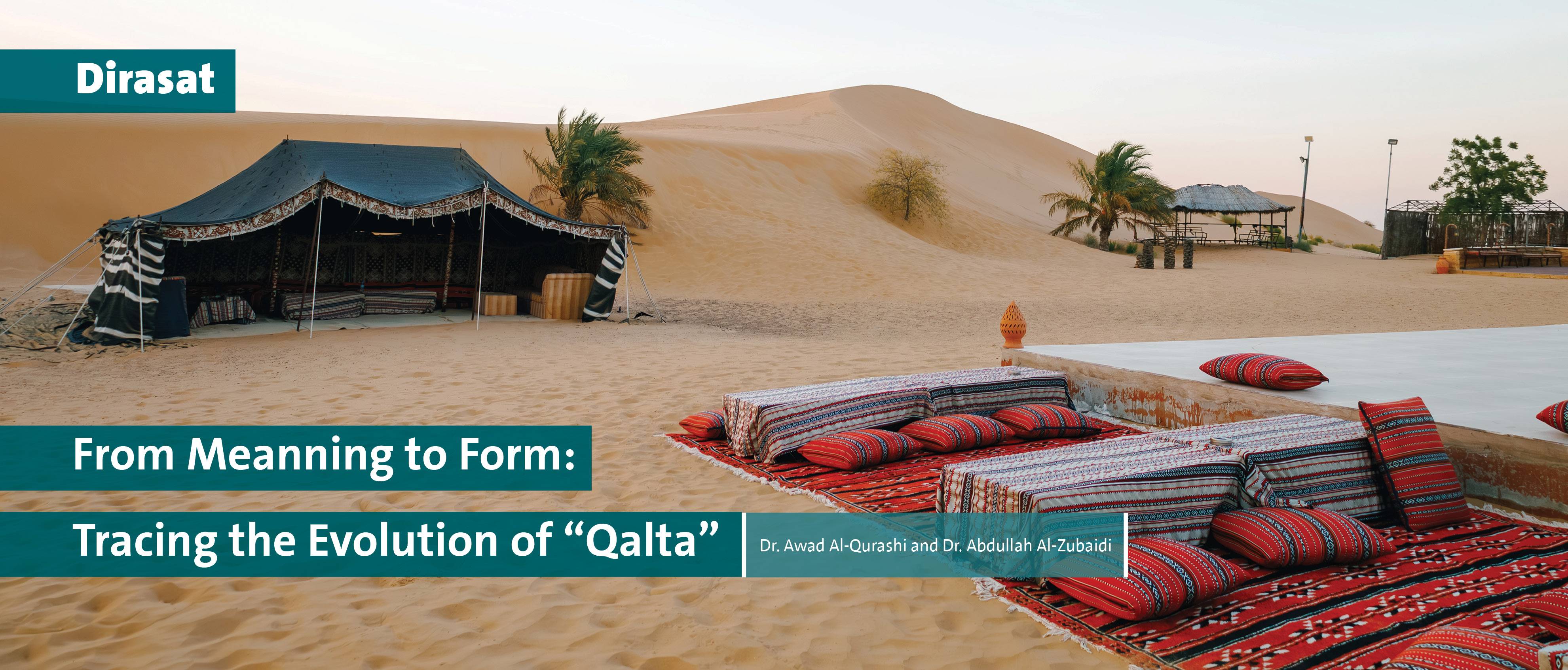
From Meanning to Form: Tracing the Evolution of “Qalta”
One of the striking aspects of the Arabian desert culture is the fascination with and captivation by encryption and coding in human communication, both verbal and non-verbal. In certain contexts, people use indirect symbols to convey requests, reprimands, challenges, tests, or other forms of social interaction. For example, in Arabian tradition, a guest’s refusal to drink the first cup of coffee offered is understood as an implicit sign of a request or as a subtle expression of reproach. In contrast, serving a cup beyond its customary limit is often perceived as an implicit sign of disrespect or a diminished sense of esteem. Likewise, certain customs of food presentation embody symbolic gestures that function as non-verbal codes infused with nuanced meanings and subtle riddles. The same principle applies to oral traditions, such as al-Zumāla (al-ḥidāya) and Qalṭa poetry. Renowned for its uniqueness and artistic allure, Qalṭa merges the intellectual challenge of deciphering layered meanings with the performative skill of exchanging riddles between poets, all while adhering to strict metrical, rhyming, and melodic conventions and ensuring impeccable delivery. It is therefore evident that this art is gaining increasing popularity, especially given the attention devoted by certain media and cultural institutions to presenting it as a cultural element that characterizes the Kingdom of Saudi Arabia.