The Desert in Mohammed Al-Thubaytī’s Poetry: Between Aesthetic and Cultural Functions
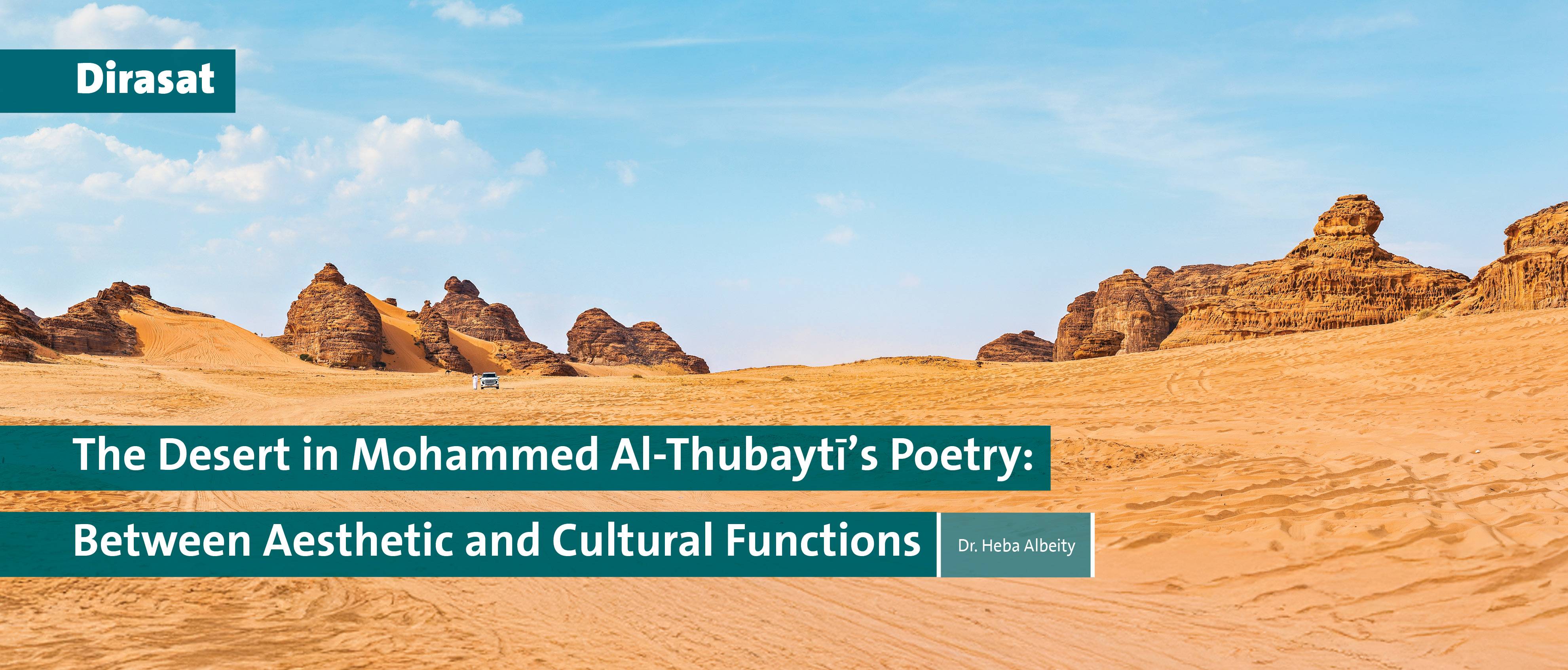
This research asserts that, for Al-Thubaytī, the desert transcended its mere geographical existence. It ebbed and flowed through his verses as a sentient being, perpetually in motion, seeking its essence within the poet’s words and anticipating the reverberations of his verse. While the desert resided within the very fabric of his writings, it also trailed behind him, the grains of its sands refining his every stride: “I arrived hastily, with the desert trailing me; the script of the sand weaving through my footfalls.” The poet’s creation of this imaginary desert serves as implicit evidence of the profound existential alienation he grapples with, while also acting as a tool for resistance and adaptation. Essentially, through his poetry, the poet endeavors to transform his desert into a homeland, finding solace in his exile within it and seeking a fictitious realm to counter and ease the harshness of his detachment. This constructed desert, envisioned by the poet, serves as both a gathering place and a sanctuary for expatriates. These wanderers are drawn to Al-Thubaytī’s desert, recognizing within its midst a reflection and symbol of their existential alienation and emotional disorientation as they navigate the quest for meaning in life. Hence, the desert in his poetry serves not only an aesthetic function but also carries cultural and emotional significance, providing an alternative portrayal for those seeking a gentler interpretation of reality. From this perspective, this research aims to explore the theme of the desert in Mohammed Al-Thubaytī’s poetry as a pivotal element of Arabian Peninsula culture. By analyzing Al-Thubaytī’s poems and considering his poetic project, we delve into a study of the culture that shaped him and the desert landscape it portrays. It is nearly impossible to separate the literary aspects from the social and cultural contexts, as stated by Saad Al-Sowayan: “Discussing the content, imagery, and meanings of poetry equates to discussing the content, components, and elements of culture—material, intellectual, and psychological. Consequently, it is challenging to isolate linguistic and literary discussions from social and cultural dialogues.” In Al-Thubaytī’s poetry, the desert is not merely a physical location but rather an imagined space. It serves as both a sanctuary from existential alienation, which arises from the clash between urban life and the desert, and
a symbol of this very alienation.